Chicken is done when the thickest part reaches 74°C (165°F), ground meat at 71°C (160°F), and a whole cut of beef or lamb at 63°C (145°F). Cook eggs until the yolk and white are firm, and reheat leftovers until they are steaming hot all the way through.
Safe internal temperature chart
Measure in the center of the thickest part, not on the surface. These are general guidelines from food safety agencies. Where they differ, we list the more cautious number first.
| What you are cooking | Internal temperature | Sign that it is done |
|---|---|---|
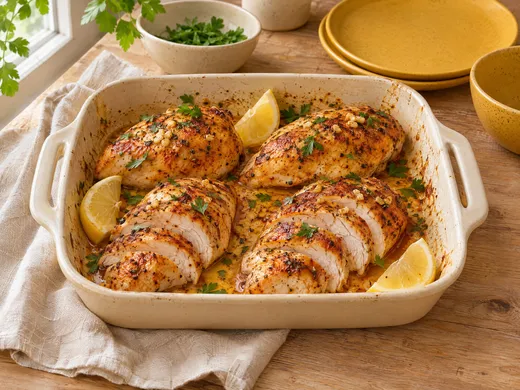
| Chicken and turkey pieces: breasts, thighs, drumsticks, wings | 74°C (165°F) | No pink near the bone, clear juices |
| Whole chicken | 82°C (180°F) in the thigh (US: 74°C / 165°F) | Thigh is not pink, even at the bone |
| Ground chicken or turkey, such as chicken patties | 74°C (165°F) | White all the way to the center |
| Ground beef or lamb: kebabs, meatballs, burgers | 71°C (160°F) | No pink in the center |
| Whole cuts of beef, veal or lamb: steaks, roasts | 63°C (145°F), then rest 3 minutes | Well seared on every side |
| Fish | 70°C (158°F) (US: 63°C / 145°F) | Opaque, flakes with a fork |
| Eggs and egg dishes | 74°C (165°F) | Firm yolk and white |
| Reheated leftovers | 74°C (165°F) | Steaming in the middle; soups and sauces boiling |
For beef, 63°C (145°F) is medium-rare. If you like it more done: 71°C (160°F) for medium and 77°C (170°F) for well done.
How to measure
- Push the thermometer into the thickest part, to the center, without touching bone.
- For a patty or burger, go in from the side to the middle.
- When cooking several pieces, check each one, or at least the thickest ones.
- Wash the thermometer in hot, soapy water after each use, since it has touched raw meat.
No thermometer?
A thermometer is the only sure way, because color and texture can fool you. Without one, these are the signs to look for, and when in doubt, keep cooking a few minutes and check again:
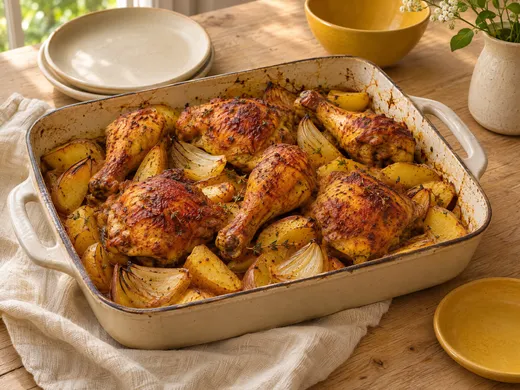
- Chicken: cut into the thickest part, next to the bone. No pink meat, and the juices run clear, not pinkish. That is how to check our Roasted Chicken and Potatoes.
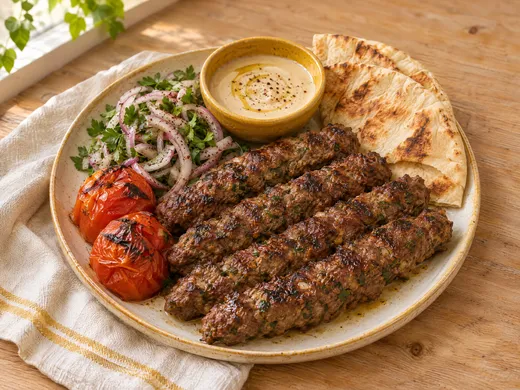
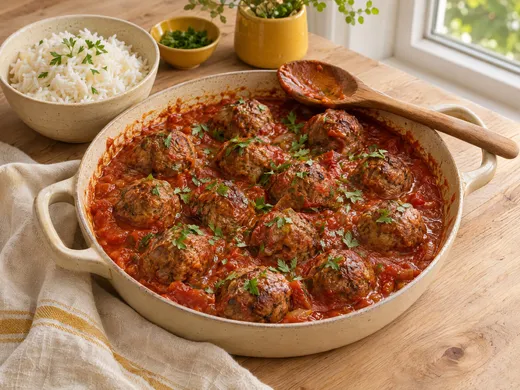
- Meatballs, kebabs and ground meat: cut the biggest one in half. Grinding spreads bacteria all through the meat, so it has to be cooked to the center, with no pink. For our beef kebabs, check the thickest one.
- A whole cut of beef: here the bacteria sit mostly on the surface. A steak seared well on every side can stay pink inside. This applies only to whole cuts, never to chicken or ground meat.
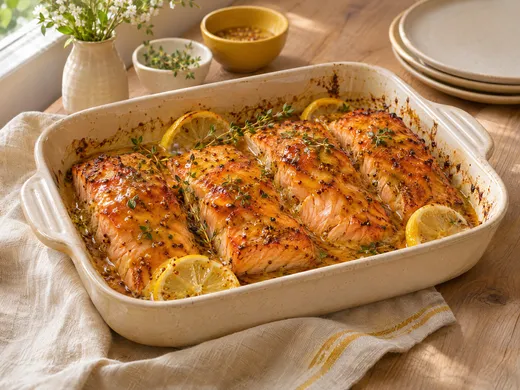
- Fish: the flesh turns white and opaque and flakes easily with a fork, as in our Honey Mustard Baked Salmon.
- Stews and leftovers: steam rises from the middle when you cut or stir, not only from the edges.
Don’t wash raw chicken
Many of us grew up rinsing chicken in the sink, but health bodies in Israel and around the world advise against it. Rinsing does not remove bacteria; it spreads them. Drops of water from the chicken can travel about 50 cm (20 inches) onto the counter, the sink and any vegetables nearby. Campylobacter, a common bacterium in chicken, can make you sick in very small amounts. Cooking is what kills it.
What to do instead: take the chicken straight from the package to the pan or pot. If you need to clean off bits of feather or fat, use a paper towel and throw it away right away. Then wash your hands.
Cross-contamination: board, knife and hands
- Use two cutting boards: one for raw meat, chicken and fish, and one for vegetables, bread and anything that will not be cooked.
- Wash your hands with soap and water for at least 20 seconds after touching raw meat, chicken, fish or eggs.
- Wash the knife, board and counter in hot, soapy water as soon as you are done.
- Never put cooked meat back on the plate that held it raw.
- In the fridge, keep raw meat, chicken and fish, including anything marinating, on the bottom shelf in a closed container or bowl, so juices cannot drip onto ready-to-eat food.
Three safe ways to thaw
- In the fridge. The safest way. Put the meat or chicken in a bowl on the bottom shelf. Chicken needs about 24 hours per 2.5 kg (5 lb), so move it from the freezer a day or two ahead.
- In cold water. Seal it in a leak-proof bag, submerge it completely in cold water and change the water every 30 minutes. Cook it as soon as it has thawed.
- In the microwave. On the defrost setting, and only if you cook it right after.
Never thaw on the counter or in hot water. The outer layer warms into the range where bacteria multiply fast, long before the center thaws.
Do not put fully thawed raw meat or chicken back in the freezer. If it still has ice crystals, you can. And once it is cooked, you can freeze the finished dish.
Leftovers: cool fast, reheat once
- Refrigerate within 2 hours of cooking, or within 1 hour on a hot day above 32°C (90°F).
- Divide a big pot into several shallow containers so the food cools quickly.
- Reheat to 74°C (165°F), until steaming in the middle. Bring soups and sauces to a boil.
- In the microwave, stir halfway through so no cold spots remain.
- Reheat only what you will eat, and reheat each portion only once.
For how long each food keeps in the fridge and freezer, see our food storage guide.
Eggs, and a note on pregnancy
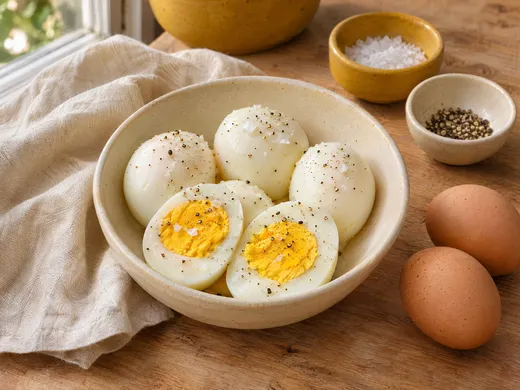
The safe rule is to cook eggs until the yolk and white are firm, like a hard-boiled egg, and egg dishes to 74°C (165°F). Soft-boiled or runny eggs carry more risk, especially for young children, older adults, pregnant women and anyone with a weak immune system. Desserts that classically use uncooked eggs can be made without them: try our chocolate mousse without eggs and tiramisu without raw eggs.
In pregnancy, the rules get stricter. The general advice is to eat eggs, chicken, meat and fish only when thoroughly cooked, and to choose pasteurized dairy. Your national health authority (in Israel, the Ministry of Health) sets the full, current guidelines, and your doctor or midwife is the one to ask about your own situation.